News ·
AI for Planning: Why Accuracy Matters
AI is becoming a growing topic in urban planning for property development.
Many planners, certifiers, architects, builders and developers are curious about what it can do. That curiosity makes sense. Planning work often involves large volumes of legislation, policies, maps, planning instruments, development controls and site-specific constraints. If technology can help read, organise and explain that information more quickly, it can save a lot of time.
But many practitioners who have trialled general AI tools are also finding the same problem: the answers often are not good enough.
The issue is not that AI is useless. The issue is that planning is difficult.
A planning answer is only useful if it is based on the right rules, the current rules, the correct maps, and the right interpretation of how those rules apply to a specific site and development type.
Why general AI tools struggle with planning
Planning rules are not simple text documents that can be summarised in isolation.
A correct answer may depend on:
- the current LEP, DCP, SEPP or local policy;
- whether a rule has been amended or replaced;
- how a zone, clause, schedule or map layer applies to the land;
- whether a more specific rule overrides a general one;
- whether an exception, exclusion or savings provision applies;
- the exact land use being proposed;
- site constraints such as heritage, flooding, bushfire, biodiversity, acid sulfate soils, coastal risk or transport access;
- and how all of these things interact.
This is where many general AI tools fall short.
They may rely on outdated material. They may misread a clause. They may overlook an important map. They may apply a general rule without checking a more specific one. They may produce wording that sounds confident, but does not follow the logic required to reach a reliable planning conclusion.
That can be risky. In planning, a wrong answer can mean wasted design work, delay, additional consultant costs, or pursuing a development pathway that was never available.
Planning knowledge and map knowledge are both essential
Good planning advice is not just about reading legislation. It also requires spatial understanding.
Many rules only make sense once they are connected to a property. A clause might apply only in a particular mapped area. A development standard might change depending on a lot size map, height map, floor space ratio map, heritage map or local constraint layer. A rule might appear to allow something, but another mapped constraint may change the answer.
This is why “AI for planning” cannot just be a chat box placed on top of a large language model.
To produce useful results, the system needs structured planning data, reliable map layers, current legislation, and logic that understands how planning instruments actually work. It needs to know which rules to check, in what order, and how to resolve conflicts or exceptions.
That takes planning expertise. It also takes serious technical work.
More than an LLM wrapper
There is a big difference between asking a general AI model a planning question and building a planning system that can analyse a property properly.
A useful system must combine legal text, planning logic, spatial data, document interpretation and careful rule management. It must be kept up to date as planning rules change. It must be tested against real examples. It must be designed around the way planning professionals actually make decisions.
This is the work PropCode has been doing for years.
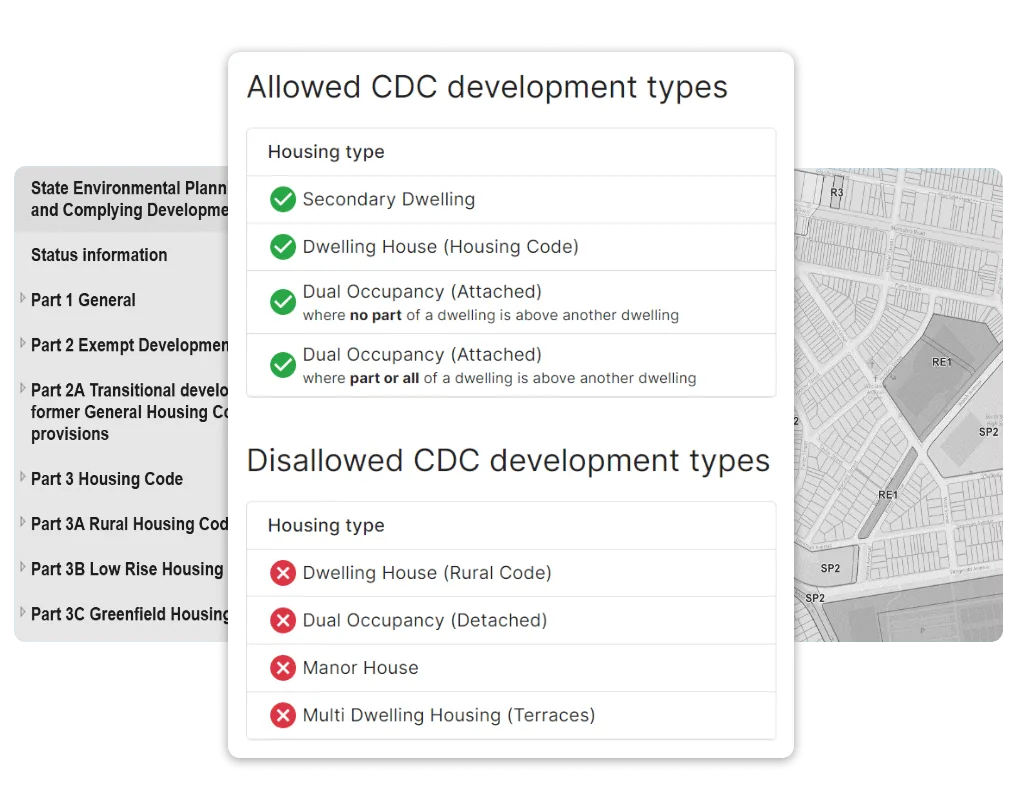
PropCode was built specifically for planning analysis. Our platform combines planning rules, maps and technical logic to help users understand what applies to a property and why. It is used by planners, certifiers, architects, builders and developers who need fast answers, but also need those answers to be grounded in the correct planning framework.
AI can be a powerful tool for planning. But only when it is used with the right data, the right logic and the right domain knowledge behind it.
That is the difference between a plausible answer and a useful one.